
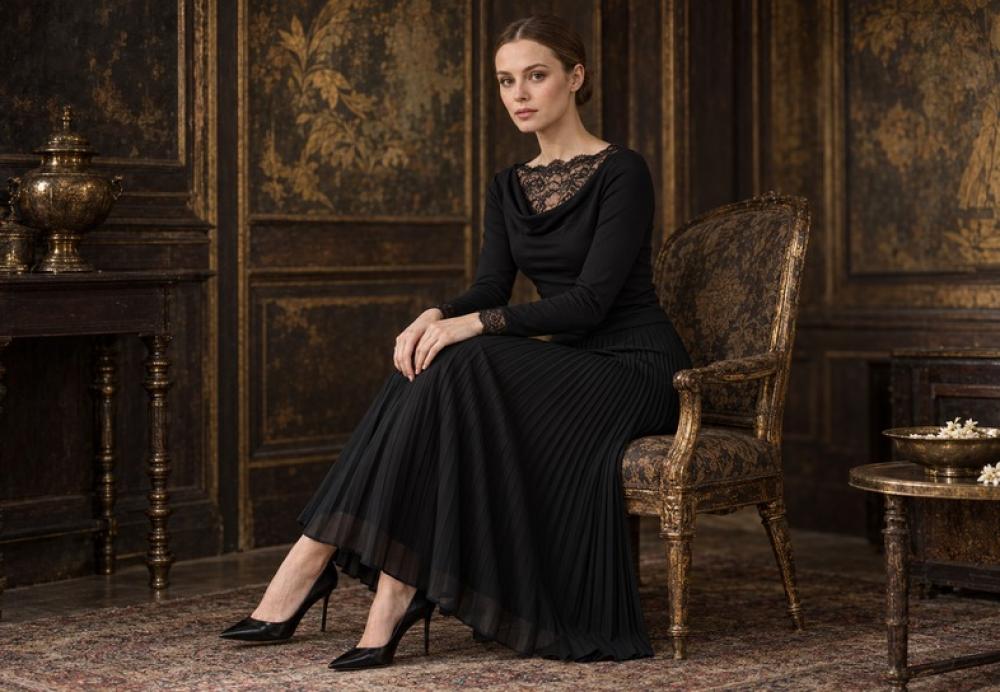
A matching set may look perfectly resolved once it is worn, but choosing its size online asks for more attention than buying a single garment.
The top may depend on the shoulders and bust. A skirt may sit at the natural waist or lower on the body. Trousers introduce another set of considerations: the rise, hip line and leg length. One size label is therefore being asked to fit two separate garments and different areas of the body.
The answer is not to choose a larger size automatically or rely on the size you usually wear elsewhere. It is to take a few accurate measurements, understand how the set is constructed and compare that information with the size guide for the specific piece.
Here is how to measure for a matching set and make a more informed choice before ordering online.
Why Matching Sets Require a More Considered Fit
A dress creates one continuous silhouette. A matching set is different: its two pieces meet the body independently.
For a top, the most relevant points may be:
- Bust
- Shoulders
- Sleeve length
- Arm opening
- Overall length
For a skirt, they may be:
- Waist
- Hips
- Where the waistband sits
- Overall length
For trousers, the decision may also depend on:
- Rise
- Inseam
- Width through the thigh
- Shape of the leg
- Whether the waistband is fixed, elasticated or adjustable
This does not make matching sets difficult to buy. It simply means the upper and lower pieces should be considered separately before being read as one outfit.
If you are still deciding whether separates or a one-piece silhouette suit your plans, read NUDA’s guide to choosing between a dress and a matching set. This guide focuses on the next step: finding the right fit once you have chosen a set.
Body Measurements and Garment Measurements Are Not the Same
Before opening a size guide, check whether it shows body measurements or finished garment measurements.
Body measurements describe your body. Garment measurements describe the dimensions of the clothing itself.
The difference between the two creates ease: the space that allows a garment to move, drape or sit away from the body. A fluid blouse will usually need more room than the body beneath it. A fitted camisole will be cut closer. Wide-leg trousers may have generous volume through the leg while still requiring a precise fit at the waist and hips.
This is why two garments marked Medium can feel entirely different. The size label may be the same, but the fabric, cut and intended silhouette are not.
International clothing measurement guidance, including ISO 8559-1, distinguishes defined body measurements used in clothing development and size designation. For the shopper, the practical principle is simple: measure the body consistently, then compare those measurements with the correct chart for the individual garment.
What You Need Before Measuring
Use a flexible measuring tape rather than a metal construction tape or rigid ruler.
You will also need:
- A mirror
- Lightweight, close-fitting clothing
- A place where you can stand naturally
- Something to record each measurement
- Another person, if possible, for shoulders and longer vertical measurements
Avoid measuring over a jumper, loose dress or padded clothing. Added volume can alter the result.
Stand naturally rather than drawing in the waist, lifting the chest or changing your posture. The aim is to record the body as it usually stands and moves.
The measuring tape should sit close to the body without compressing it. Keep it level when taking circumference measurements, and check its position in the mirror before recording the number.
How to Take the Measurements That Matter
1. Bust
Wrap the tape around the fullest part of the bust and across the shoulder blades.
Keep the tape parallel to the floor. Allow your arms to rest naturally rather than lifting them while reading the measurement.
The bust is particularly important for:
- Fitted tops
- Camisoles
- Button-front blouses
- Structured necklines
- Tops with limited stretch
For a softly draped top, the bust measurement still matters, but the intended ease may create a less fitted result.
2. Natural Waist
The natural waist is usually the narrower area between the rib cage and hips. It may be higher than the point where you prefer to wear your trousers or skirts.
Wrap the tape around this area without pulling it tight.
Once recorded, compare it with the construction of the garment. A high-waisted skirt and a lower-rise pair of trousers will not necessarily sit at the same point, even when they belong to the same nominal size.
3. Hips
Measure around the fullest part of the hips and seat, keeping your feet in a natural standing position.
Check the mirror to make sure the tape remains level at the back. If it slopes upward or downward, the resulting measurement may be too small.
The hip measurement matters even when the garment has a fluid silhouette. A skirt or pair of trousers may appear loose through the lower half while still being shaped more closely around the upper hip.
4. Shoulder Width
Measure across the back from one shoulder point to the other.
This is easier and more accurate with another person. The tape should follow the natural line across the shoulders rather than curving around the neck.
Shoulder width is especially relevant for:
- Long-sleeved tops
- Structured blouses
- Pieces with a defined shoulder seam
- Garments with fitted upper bodies
A deliberately dropped shoulder is designed differently, so always read the product’s fit description before comparing measurements.
5. Sleeve Length
Begin at the shoulder point and measure down the arm to the wrist or the intended end of the sleeve.
Keep a slight, natural bend in the elbow. Measuring a completely straight arm may produce a sleeve that feels shorter once you begin moving.
For statement cuffs or extended sleeves, look at the product photographs to understand where the design is intended to finish.
6. Inseam
The inseam runs from the upper inside leg to the preferred trouser hem.
A reliable method is to measure a pair of trousers that already fits well. Lay it flat, then measure the inside seam from the crotch to the hem.
Remember that the ideal length changes with the cut. Wide-leg trousers may be designed to fall close to the floor, while a shorter straight-leg style may finish above the shoe.
7. Skirt Length
Start from the point where the skirt’s waistband is intended to sit and measure vertically to the preferred hem.
Do not assume that every maxi skirt has the same finished length. Your height, the position of the waistband and the shoes you intend to wear will all affect where the hem falls.
How to Read a Matching Set Size Guide
Once you have recorded your measurements, do not reduce the decision to one number immediately.
Use this sequence:
- Find the closest size for the upper piece.
- Find the closest size for the lower piece.
- Note whether both pieces indicate the same size.
- Check the fabric and whether the product description mentions stretch.
- Look at the fit language: fitted, relaxed, fluid, structured or oversized.
- Review the waistband construction.
- Check the product photographs for the intended proportions and length.
- If two measurements suggest different sizes, identify which part of the set has less flexibility.
Do not convert your usual size from another store without checking the NUDA size guide. Sizing can vary between brands and sometimes between garments within the same collection.
NUDA advises comparing your measurements with the guide on the individual product page and reviewing the fit information for that piece. If you remain unsure, contact the team before ordering rather than guessing.
How Fabric and Construction Change the Fit
A measurement only becomes meaningful when read alongside the garment.
A Draped Top and Pleated Skirt
The NUDA Sandy Set combines a long-sleeved draped top with a finely pleated maxi skirt.
The folds and fluidity create movement, but they do not make every measurement interchangeable. The shoulder line, sleeve length and the point at which the skirt sits remain relevant. Pleats may create volume through the skirt, while the waistband still determines how securely it fits.
This set is currently unavailable, so it should be viewed as a useful example of construction rather than a primary shopping recommendation.
A Silk Top and Flowing Skirt
The Peachy Silk Set pairs a sleeveless, round-neck top with a flowing coordinating skirt.
Here, the key questions are different:
- Does the top sit correctly across the bust?
- Is there enough ease to preserve the fabric’s fluid line?
- Where does the skirt waistband sit?
- Will the skirt length work with the intended footwear?
A fluid fabric can skim the body beautifully, but fluidity should not be confused with stretch. Unless the product information confirms elasticity, choose the size according to the measurements rather than expecting the fabric to expand.
A Camisole and Wide-Leg Trousers
The Brown Out Set combines a satin-finish camisole with fluid wide-leg trousers. The trousers have an elasticated drawstring waist, giving the lower piece a degree of adjustment.
The camisole requires a different reading. Pay attention to the bust, neckline position and how the straps place the top on the body. An adjustable or elasticated trouser waist may offer flexibility, but it does not determine whether the upper piece will fit correctly.
This is exactly why a matching set should be measured as two garments before it is considered as one look.
What If Your Top and Bottom Usually Need Different Sizes?
This is one of the most common difficulties when buying a matching set.
Begin by identifying which piece is less adjustable.
A drawstring waist may offer more flexibility than a fitted top. A flowing blouse may be more forgiving than a fixed skirt waistband. A loose skirt may provide room through the hips while the shoulder line of the top remains precise.
Do not automatically size up without considering the complete silhouette. An unnecessarily large size may solve one measurement while causing the shoulders, neckline or waist to sit incorrectly.
Instead, ask:
- Which measurement falls outside the size range?
- Is that area fitted or relaxed?
- Does the fabric stretch?
- Is the waistband adjustable?
- Would sizing up change the intended drape?
- Can the garment be altered without disrupting its construction?
When the difference between upper and lower measurements is significant, send the NUDA team your bust, waist and hip measurements and ask about the specific set. Product-specific guidance is more useful than a general rule.
A NUDA Fit Checklist Before Ordering

Common Measuring Mistakes
Measuring Over Thick Clothing
A jumper or loose dress adds volume and can lead to choosing a larger size than necessary.
Pulling the Tape Too Tight
The tape should touch the body without pressing into it. A compressed waist or bust measurement will not reflect the space required for movement.
Using Weight Instead of Measurements
Weight does not show how proportions are distributed across the bust, waist, hips or height. Two people with the same weight may require different sizes and lengths.
Ignoring the Garment Length
A set can fit through the waist and bust while still feeling wrong because the trousers, sleeves or skirt finish at an unsuitable point.
Assuming Silk, Satin and Chiffon Stretch
A smooth or fluid surface does not automatically mean elasticity. Only rely on stretch when it is stated in the product details.
Choosing the Same Size Across Every Brand
Size labels are not universal. Use the chart provided for the garment you are buying.
Looking Only at the Model Photograph
Photography helps you understand the intended silhouette, but it cannot replace measurements. Height, proportions, styling and garment pinning can all affect how a piece appears in an image.
How to Choose Between Two Sizes
There is no responsible rule that says every shopper should choose the larger size.
If you fall between sizes, look first at the least flexible part of the set.
For a fitted top with relaxed trousers, the bust and shoulders may lead the decision. For a loose blouse with a fixed skirt waistband, the waist or hips may matter more.
Then consider how you want the garment to look. Sizing up can create more ease, but it may also shift the neckline, lower the arm opening or change the intended waist position.
The best size is not simply the one that accommodates the largest measurement. It is the one that respects the construction of both pieces while allowing you to sit, walk and move comfortably.
Before You Complete Your Order
Take your measurements once, then repeat them before making the final decision. Small differences caused by tape placement are common.
Next:
- Compare the second measurements with the product’s size guide.
- Read the full description rather than relying on the title.
- Review the front, back and side photographs.
- Check the fabric and waistband construction.
- Contact NUDA if the two pieces suggest different sizes.
- Read the current return policy before ordering.
If you plan to wear the set across several occasions, you can also explore how a coordinated outfit moves between different settings in NUDA’s day-to-night wardrobe guide.
A More Precise Way to Choose a Matching Set
A well-chosen matching set should feel composed without feeling restrictive.
Measure the upper and lower body separately. Notice where the garments are structured and where they are designed to move. Treat the size guide as a point of comparison, not as a substitute for understanding the piece.
Once fit, fabric and proportion are considered together, the size label becomes only one part of the decision. The result is a set that sits correctly, moves naturally and retains the silhouette that first drew you to it.
Explore the Peachy Silk Set and Brown Out Set, then compare your measurements with the guide provided for each design.
Frequently Asked Questions
How do I measure myself for a matching set?
Measure your bust, natural waist and fullest hip first. Depending on the set, you may also need your shoulder width, sleeve length, inseam and preferred skirt or trouser length. Compare the upper and lower measurements separately with the product’s size guide.
Should I size up when buying a two-piece set?
Not automatically. Check which piece is more fitted or less adjustable. A larger size may provide more room in one area but change the shoulders, neckline or waist position elsewhere.
What should I do if my top and bottom are different sizes?
Review the construction of both pieces and choose according to the less flexible area. If the difference is significant, contact NUDA with your bust, waist and hip measurements before ordering.
Are garment measurements the same as body measurements?
No. Body measurements describe your body, while garment measurements describe the finished clothing. The garment is often larger in selected areas to provide ease, movement or drape.
Can I use the size I normally wear in another store?
It is better to compare your current measurements with the NUDA size guide. Size labels and garment proportions can vary between brands and between different designs.